


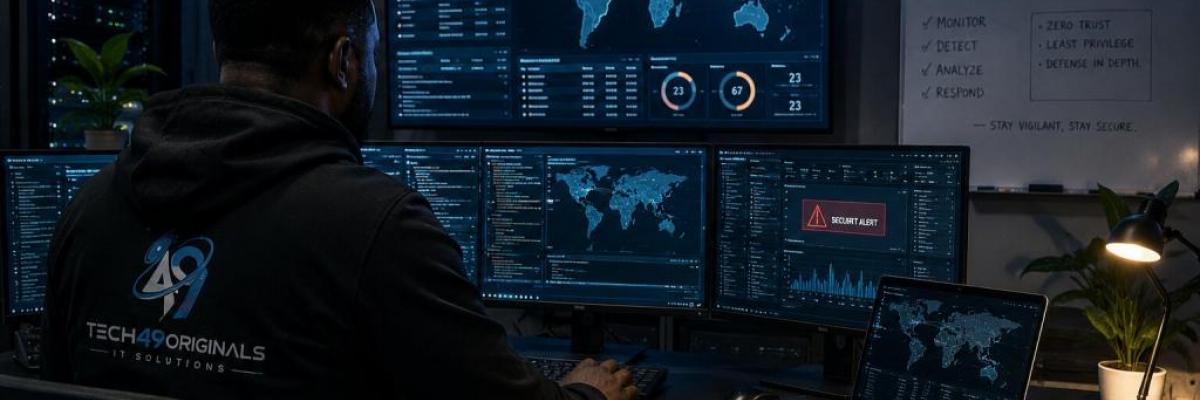
SOC and SIEM in Namibia: Detecting a Breach Before Your Customers Do
Most organisations do not discover they have been breached. They are told — by a customer whose data has appeared somewhere, by a bank flagging fraud, by a regulator, or by an attacker demanding payment. By then the intruder has usually been inside for weeks.
That gap between compromise and discovery is where nearly all the damage accumulates. Firewalls and antivirus reduce the chance of a breach. Nothing about them shortens the gap. Only monitoring does.
The Namibia Cyber Security Incident Response Team recorded 1,103,784 cyber threat instances and 1,090,342 vulnerabilities in a single six-month period of 2025, the highest since the national body was established. In the first quarter of 2026 it logged a further 103,085 threat incidents and 367,670 vulnerabilities. CRAN recently alerted 13 local organisations whose security devices were compromised in the FortiBleed incident. Those organisations did not volunteer to be targets. They had an internet-facing device, which is the only qualification required.
Tech49Originals IT Solutions provides SOC and SIEM services in Namibia from Windhoek.
What the terms actually mean
SIEM — Security Information and Event Management — is the technology. It collects logs from servers, firewalls, endpoints, cloud accounts and applications, then correlates them. Correlation is the point. A failed login means nothing. Four hundred failed logins from one address, then one success, then an unusual data transfer at 03:00, is an incident. No single system sees that pattern. The SIEM does.
SOC — Security Operations Centre — is the people. A SIEM generates alerts continuously and most are noise. Without someone qualified to triage them you have bought an expensive machine for producing anxiety. The SOC investigates, discards false positives, escalates real threats and advises on response.
Both are needed. A SIEM without a SOC is unread alerts. A SOC without a SIEM is skilled people with no visibility.
Why Namibian organisations struggle here
Meaningful in-house monitoring means SIEM licensing, log storage and analysts — plural, because 24-hour coverage cannot be one person. Add recruitment in a market where experienced security analysts are scarce and internationally mobile, then retention against employers who pay more.
For most Namibian businesses that is not a budget question but an impossibility. Managed SOC and SIEM services fill the gap by sharing analyst capacity across clients, so each gets professional monitoring at a fraction of building it alone.
What Tech49Originals delivers
Log collection and correlation across the whole environment, because attackers move between segments and partial visibility produces partial detection. Threat detection and triage by people, so clients receive escalations that matter rather than a dashboard to interpret themselves. Actionable response guidance explaining what happened, what to isolate and what to change, written in language a director can act on. Incident response support to contain and remediate, then close the entry route permanently. And reporting, increasingly requested by insurers, partners and larger clients running vendor security reviews.
Four honest tests
Does the organisation hold customer personal data? Namibia's Data Protection Bill has cleared the cabinet committee on legislation, and undetected breaches will move from embarrassing to legally consequential.
Does it process payments? Financial systems attract targeted, persistent attackers.
Do staff work remotely or use personal devices? Every remote endpoint is a route in, outside the network perimeter.
Could the organisation answer whether anyone has accessed its systems without authorisation in the past ninety days? If the honest answer is that nobody would know, that is the case for monitoring stated plainly.
Questions to ask any provider
Is a human reviewing alerts, or only automation? Fully automated services are alert forwarding with a better name. What are the response times, and are they contractual? Where are logs stored and for how long — investigating an intrusion that began four months ago requires four months of logs. What is genuinely in scope? What happens during an incident: advice only, or hands-on containment? Who owns the data on exit?
Monitoring is not a substitute for the basics
An honest caveat. SOC and SIEM detect intrusions; they do not prevent the conditions that make intrusion easy. With unpatched internet-facing systems, no multi-factor authentication, shared administrator passwords and untested backups, monitoring will faithfully document a compromise in real time. Better than not knowing, but the money is better spent on fundamentals first. Tech49Originals will say when that is the situation, and would rather run a vulnerability assessment, help fix what it finds, and monitor an environment worth monitoring.
Tech49Originals provides SOC and SIEM monitoring, penetration testing, vulnerability assessments and incident response planning to organisations across Namibia.
Website: www.tech49originals.com
Email: [email protected]
Phone / WhatsApp: +264 81 806 8136